


 |
| Plaster relief of bull's head by Picasso. |


 |
| Back in downtown Havana, this is a popular destination for tourists who come to see where Hemingway hung out. The "cradle" of the daiquiri. |
 |

|
| Plaster relief of bull's head by Picasso. |
|
| Back in downtown Havana, this is a popular destination for tourists who come to see where Hemingway hung out. The "cradle" of the daiquiri. |
|
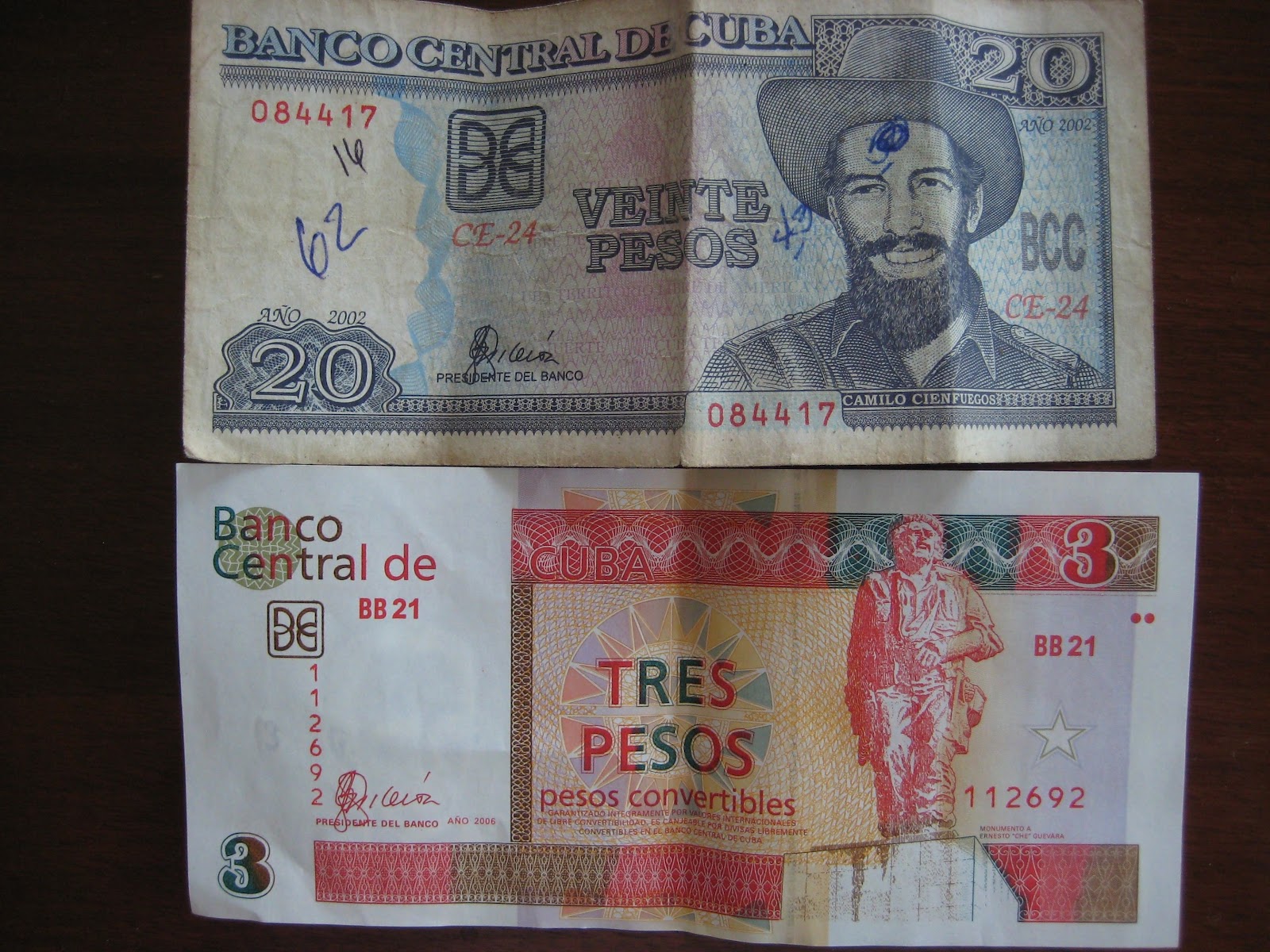
 There are two money systems in Cuba. The Cuban Convertible peso or CUC [kook] is the accepted money interchange for the tourist economy. The exchange rate for Canadians and Europeans does not include any surcharge, but Americans do pay a surcharge for converting to Cuban dollars [also called pesos]. For $100 USD, the return is $87.30 CUCs, as shown on this hotel board. Our guide said a higher standard of living is available to a Cuban, the closer he or she is to the CUC economy.



 |
This band, named Cuarteto Esperanza, played at La Imprenta, a former newspaper/printing press, now converted to a restaurant. They passed around CDs for purchase after their performance. Their style was partly Cuban salsa, and partly Latin romantic, e.g. Besame Mucho.
There may be a music sample at this photo location in the future.
|
 |
| Art cards from the Fine Arts Museum. |
 |
| Wifredo Lam grew up in Cuba and studied in Europe in the 1920s and 1930s. He became associated with Picasso and other great painters in France at the time. He exhibited with Picasso in New York in 1939.
With the outbreak of World War II and the Germans invading Paris, Lam left for Marseille in 1940. There, he rejoined many intellectuals, including the Surrealists, with whom he had been associated since he met André Breton in 1939. In Marseille, Lam and Breton collaborated on the publication of Breton's poem Fata Morgana, which was illustrated by Lam. Though the drawings he created in Marseille between 1940 and 1941 are known as the Fata Morgana suite, only about three inspired the illustrations for the poem. In 1941, Breton, Lam and Claude Lévi-Strauss, accompanied by many others, left for Martinique only to be imprisoned. After forty days, Lam was released and allowed to leave for Cuba, which he reached in midsummer 1941. [Source: Wikipedia.]
|


 |
| Some of these older buildings may be hotels. They illustrate the architectural detail which remains, despite decades of insufficient funds for upkeep. |


 |
| The Hotel Nacional, above, operates today and also remembers its heyday with posters of famous visitors from the decades, here the '30s, the '40s, and the '50s. |


 |
| Efficiency in Mojito production at La Nacional! |
 |
| Lobby of the Parque Central, an Iberostar property. |

 |
| The Riviera, built in the '50s and not a form of architecture we admire today, has a colorful pre-revolutionary history, as quoted here from Wikipedia:
The hotel was owned and operated by Riviera de Cuba S.A. company, which was established by Meyer Lansky, though the incorporation papers listed the names of Miami hotel operators, a Canadian textile company and several others. It was built at a cost of US $8 million, most of which was provided by the Bank for Economic and Social Development (BANDES), a state-run development bank set up by Fulgencio Batista.[1]
Lansky’s investment partners included some of Las Vegas’s biggest power brokers, among them his old friends Moe Dalitz, Morris Kleinman, Sam Tucker, and Wilbur Clark of the Desert Inn (and of Lansky’s Hotel Nacional casino); Edward Levinson of the Fremont Hotel; and Hyman Abrams and Morris Rosen of the Flamingo Las Vegas (of Bugsy Siegel fame). As with all of Lansky’s dealings, he and his underworld associates’ ownership of the Riviera was hidden behind layers of managers and front men.
Work began on the 21-story hotel, located on the Malecón right next to the Meliá Cohiba Hotel, in December 1956 in the midst of the revolutionary upheaval. Not since the Nacional was constructed was there such resort excitement in Cuba. Already envisioned as “The Riviera of the Caribbean”, it was considered the epitome of resort-construction, and certainly was one of the more costly hotels in Cuba. It was also the first of its kind in Havana to have air-conditioned rooms. Each room had a view of the Gulf of Mexico, with the hotel itself within sight of not only busy Havana but also the quiet splendor of the residential Miramar and Country Club sections.
|


